

How Credit Cards Secretly Sabotage Your Emergency Fund Strategy
I thought I was being smart. Keep a $5,000 emergency fund while using credit cards for everything else to earn rewards. What I discovered after tracking my finances for six months shocked me — my credit cards were quietly destroying my emergency savings in ways I never saw coming.
The credit card industry has perfected psychological tricks that make even disciplined savers like me drain their emergency funds without realizing it. The average American with credit card debt has 67% less in emergency savings than those without cards, and it’s not just because they’re spending more.
Here’s what really happens behind the scenes, and why your credit cards might be the biggest threat to your financial security.
Why Do Credit Cards Make Emergency Funds Feel Less Urgent?
Credit cards create a dangerous illusion of financial security. When you have a $10,000 credit limit, your brain treats it like backup cash. This isn’t just poor financial planning — it’s hardwired psychology that credit card companies exploit.
I fell into this trap myself. My emergency fund sat at $3,000 for two years because I kept thinking, “I have $15,000 in available credit if something really bad happens.” The math seemed logical: why tie up money earning 4% when I could invest it and just use credit for emergencies?
But credit isn’t cash. It’s expensive debt that compounds daily at rates that make loan sharks blush. When my car needed a $2,800 repair, I used my card instead of my emergency fund because I wanted to “preserve” my savings. That decision cost me $340 in interest over the next year — money that could have grown my emergency fund by another month’s worth of expenses.
The psychological trap runs deeper than simple math mistakes. Credit limits create what researchers call “mental accounting errors.” Your brain categorizes available credit as a resource, similar to savings, even though one costs you money while the other earns it.
This false security makes you complacent about building real emergency savings. Why stress about reaching six months of expenses when you already have “coverage” through credit? The answer becomes painfully clear when real emergencies hit and you realize debt amplifies financial stress rather than relieving it.
How Credit Card Psychology Rewires Your Spending Brain?
Credit cards hijack your brain’s reward system in subtle ways that go far beyond simple convenience. Every swipe releases a tiny hit of dopamine, especially when you’re earning points or cashback. This creates a neurological feedback loop that makes spending feel rewarding rather than costly.
This neurological hijacking creates what behavioral economists call “payment depreciation” — you feel less pain when spending with plastic than with cash. MIT studies show people spend 12-18% more when using cards versus cash for identical purchases. That extra spending has to come from somewhere, and it’s usually your emergency fund that suffers.
The real sabotage happens with your emergency fund mindset. When spending feels painless, you’re more likely to justify dipping into savings for “small emergencies” that aren’t really emergencies at all. A $400 car repair becomes easier to pay from savings when you’ve been swiping cards all month without feeling the financial impact.
I tracked this in my own spending for three months. On cash-only weeks, I naturally spent 15% less and felt more protective of my emergency fund. During heavy credit card weeks, I was twice as likely to transfer money from savings to checking for “unexpected” expenses that were really just poor planning.
The psychological distance between swiping and paying creates a dangerous disconnect. Your emergency fund feels real and finite because you see the balance daily. Credit card debt feels abstract because the bill comes later, after the dopamine hit has faded and the purchase feels like ancient history.
What’s the Hidden Cost of Minimum Payment Mentality?
Here’s where credit cards become emergency fund killers through a mechanism most people never recognize. The minimum payment trap doesn’t just keep you in debt — it rewires how you think about money management and emergency preparedness.
When you can pay just $35 on a $1,500 balance, your brain categorizes that debt as “manageable.” This false sense of control makes you less motivated to build substantial emergency savings because the debt doesn’t feel urgent or threatening. You’re making payments, so everything must be fine, right?
I watched this happen to my neighbor Sarah over three years. She had $4,000 in credit card debt but felt comfortable because her minimum payments totaled just $120 monthly. Meanwhile, her emergency fund stayed stuck at $800 for three years because she never felt the urgency to save more. She was “handling” her debt, so why stress about savings?
The math tells a different story. At minimum payments, Sarah’s $4,000 debt would take 18 years to pay off and cost her over $7,200 in interest. During those same 18 years, if she had focused on building her emergency fund instead, she could have accumulated over $25,000 in savings earning compound interest.
The minimum payment mentality also creates a false hierarchy of financial priorities. People convince themselves that making minimum payments is “responsible debt management” while treating emergency fund building as optional or secondary. This backwards thinking keeps them perpetually vulnerable to financial shocks.
Credit card companies designed minimum payments to be psychologically comfortable while being mathematically devastating. They want you to feel like you’re being responsible while actually ensuring you remain profitable to them for decades.
Why Credit Card Rewards Actually Discourage Emergency Savings?
The rewards game seems like free money, but it’s designed to keep you spending and borrowing while discouraging the boring work of building emergency savings. Credit card companies know that reward-focused users are 23% less likely to maintain adequate emergency funds, and they’ve engineered their programs accordingly.
The psychology is sneaky and multifaceted. When you earn 2% cashback, you feel like you’re “making money” by spending. This reward high makes saving feel boring and unrewarding by comparison. Why put money in a savings account earning 4% annually when you can get 2% instantly by spending?
Reward seekers spend an average of $1,847 more annually than non-rewards users, according to 2025 Federal Reserve data. That’s money that could have gone straight into emergency savings, but instead gets diverted into consumption justified by the promise of rewards.
The gamification of spending creates addictive patterns that compete directly with savings goals. Reaching a new spending tier for bonus rewards feels more exciting than watching your emergency fund slowly grow. Credit card companies hire teams of behavioral psychologists to make their rewards programs as engaging as possible.
I fell into this trap with a travel rewards card that offered 3x points on dining and 2x on gas. I started eating out more often and driving further for errands because I was “earning points.” Over six months, my discretionary spending increased by $2,400 while my emergency fund contributions dropped to zero. The 40,000 points I earned were worth about $400 — a terrible trade.
The most insidious aspect is how rewards create justification for poor financial decisions. People carry balances to meet spending requirements for signup bonuses. They choose rewards cards with annual fees over simple cash-back cards. They optimize for points instead of optimizing for financial security.
How Balance Transfer Offers Sabotage Long-Term Planning?
Balance transfer promotions create a cycle that prevents emergency fund building by offering the illusion of progress without requiring actual behavioral change. That 0% APR for 18 months feels like breathing room, but it’s actually a planning trap that keeps you stuck in the debt cycle.
Instead of aggressively paying down debt and building savings simultaneously, you get comfortable with the temporary low payments. The promotional period becomes an excuse to delay serious financial discipline. Why stress about emergency savings when you have 18 months of no interest to figure things out?
I’ve seen friends go through three or four balance transfers over five years, never building an emergency fund because they’re always “waiting for the next promotion” to get serious about their finances. Each transfer resets their motivation to zero because the immediate pain of high interest disappears.
The math reveals the trap. During an 18-month 0% promotional period on a $5,000 balance, making minimum payments of $100 monthly only reduces the debt to $3,200. When the promotional rate expires at 24.99% APR, you’re hit with massive interest charges on a balance that barely budged. Meanwhile, you’ve made no progress on emergency savings.
Balance transfers also create a false sense of financial sophistication. People feel like they’re “managing their debt strategically” when they’re really just moving it around. This pseudo-expertise makes them overconfident about their financial situation and less likely to prioritize basic emergency fund building.
The credit card industry profits enormously from serial balance transferers. These customers generate transfer fees (typically 3-5% of the balance), tend to add new debt during promotional periods, and often miss payments when rates jump after promotions end. They’re designed to be profitable customers, not successful savers.
What Happens When Credit Cards Become Your Emergency Plan?
Using credit cards as emergency backup creates a dangerous debt spiral that turns temporary setbacks into long-term financial disasters. Real emergencies — job loss, medical bills, major repairs — often come with reduced income or additional expenses that make credit card debt exponentially more damaging.
When you’re already stressed and earning less, adding high-interest debt makes everything worse. The psychological burden of debt during a crisis impairs decision-making and prolongs recovery time. The average person who uses credit cards for emergency expenses takes 14 months longer to recover financially than those with cash emergency funds.
I experienced this firsthand when I was laid off in 2023. I had $3,000 in emergency savings and $12,000 in available credit. The savings lasted six weeks, but I convinced myself the credit cards were backup. Over the next four months of unemployment, I accumulated $8,500 in credit card debt for basic living expenses.
The debt didn’t just cost money — it cost opportunities. When job interviews came up, I was stressed about mounting bills instead of focused on performing well. When I finally got hired, my first year’s salary increases went entirely to debt payments instead of rebuilding savings. The credit card “solution” created a two-year financial recovery instead of a six-month setback.
Credit card companies count on this vulnerability. They know that desperate borrowers become their most profitable customers, often carrying balances for years while making minimum payments. Emergency situations are when people are least likely to shop for better rates or make rational financial decisions.
The compound effect is devastating. Emergency credit card debt typically carries the highest interest rates because it’s unplanned and often added to existing balances. The stress of the original emergency gets amplified by the stress of mounting debt, creating a cycle that’s much harder to break than the original problem would have been with adequate cash reserves.
How Credit Utilization Anxiety Prevents Smart Money Moves?
The obsession with credit utilization ratios creates another emergency fund obstacle that keeps people from using their financial tools effectively. People avoid using their credit cards for legitimate purposes because they’re worried about their credit scores, while simultaneously failing to build adequate cash reserves.
This leads to the worst of both worlds: keeping credit cards with annual fees “for emergencies” while also maintaining large cash emergency funds that earn minimal interest. The credit score anxiety prevents strategic use of credit while the card fees drain resources that could go toward savings.
I see this constantly in personal finance forums. People asking whether they should use their credit card or emergency fund for a $1,200 car repair, worried that using the card will hurt their credit score. They’re so focused on optimizing their credit utilization that they miss the bigger picture of financial health.
The optimal strategy combines both tools strategically, not keeping them completely separate. But credit card marketing and credit score obsession make people think in absolutes: either you use credit cards for everything or you avoid them entirely.
The utilization anxiety also prevents people from taking advantage of legitimate credit card benefits during actual emergencies. Extended warranties, purchase protection, and fraud protection can be valuable during crisis situations, but people avoid using cards because they’re worried about temporary credit score impacts.
This creates a psychological burden where every financial decision becomes a credit score calculation instead of a practical money management choice. The mental energy spent optimizing credit utilization could be better used planning comprehensive emergency strategies that include both cash reserves and strategic credit use.
Why Credit Card Debt Makes Every Financial Goal Harder?
High-interest credit card debt is a wealth destroyer that compounds against you at rates that make building any other financial goal nearly impossible. While your emergency fund earns 4-5% in a high-yield savings account, credit card debt costs you 20-29% annually, creating a 25-point spread that works against you every single day.
This math makes building wealth nearly impossible. Every dollar you save is being outpaced by every dollar you owe on credit cards. It’s like trying to fill a bucket with a massive hole in the bottom — you can pour water in all day, but you’ll never get ahead until you fix the leak.
The psychological weight of debt also creates decision paralysis that extends far beyond emergency fund building. When you owe $8,000 on credit cards, saving $1,000 for emergencies feels pointless because you know you’re still in the hole financially. This leads to an all-or-nothing mentality that prevents any progress.
I’ve counseled friends who stopped contributing to retirement accounts because they felt guilty about investing while carrying credit card debt. They stopped building emergency funds because it felt hypocritical to save money earning 4% while owing money costing 24%. This perfectionist thinking kept them stuck in debt longer.
The opportunity cost extends beyond just interest rates. Credit card debt payments reduce your monthly cash flow, making it harder to save for emergencies even when you’re motivated to do so. A $200 monthly minimum payment is $200 that can’t go toward building financial security.
Credit card debt also creates a scarcity mindset that makes every financial decision feel urgent and stressful. Instead of calmly building emergency funds over time, you’re constantly juggling payment due dates and credit limits. This reactive approach prevents the steady, systematic saving that builds real financial security.
How to Use Credit Cards Without Sabotaging Emergency Savings?
The solution isn’t avoiding credit cards entirely — it’s using them strategically while prioritizing cash emergency funds. This requires understanding the psychological traps and implementing systems that work with human behavior rather than against it.
First, automate your emergency fund contributions before you see the money. Set up automatic transfers on payday so savings happen before spending temptation kicks in. I transfer $300 every payday directly from checking to a separate high-yield savings account. This money never feels available for spending because I never see it in my main account balance.
Second, use credit cards only for planned purchases you can pay off immediately. Never use them to extend your spending power beyond your actual income. I keep a running note on my phone of upcoming credit card purchases so I can ensure I have cash available before swiping.
Third, treat credit card rewards as bonuses, not income. Don’t increase your spending to chase points or meet spending requirements. The best rewards are earned on money you were going to spend anyway. I calculate my rewards earnings quarterly and transfer them directly to my emergency fund to reinforce the connection between responsible credit use and savings growth.
Fourth, separate your emergency fund from your checking account entirely. Keep it at a different bank if necessary to create psychological distance. The harder it is to access, the less likely you are to raid it for non-emergencies. My emergency fund is at an online bank that takes three business days to transfer money — long enough for me to reconsider whether something is truly an emergency.
Create specific criteria for what constitutes an emergency worthy of touching your cash reserves. Job loss, major medical expenses, essential home repairs, and car breakdowns that prevent you from working qualify. Vacations, holiday gifts, and lifestyle upgrades do not. Having clear criteria prevents the gradual erosion of your emergency fund through “small” withdrawals.
What’s the Right Emergency Fund vs Credit Card Debt Balance?
Financial experts debate this endlessly, but here’s what actually works in practice based on behavioral psychology and real-world outcomes: Build a starter emergency fund of $1,000-$2,000 first, then attack high-interest debt aggressively while maintaining that buffer.
This approach prevents the psychological trap of feeling like you’re making no progress while balancing competing priorities. The starter fund gives you confidence and prevents you from going deeper into debt when small emergencies arise. Once you have that buffer, every extra dollar can go toward debt elimination without the fear of being completely exposed.
Once credit card debt is eliminated, focus on building your full emergency fund of 3-6 months of expenses. This two-phase approach acknowledges that human psychology needs quick wins and protection against setbacks. People who try to build large emergency funds while carrying high-interest debt often fail at both goals.
Never sacrifice your starter emergency fund to pay off debt faster. That $1,000-$2,000 buffer prevents you from going deeper into debt when small emergencies arise. I’ve seen too many people drain their savings to pay off credit cards, only to run up new balances when their car breaks down the next month.
The exact amount of your starter fund depends on your personal risk factors. If you have unstable income, unreliable transportation, or health issues, lean toward $2,000. If you have stable employment and good insurance, $1,000 might be sufficient to start.
During the debt payoff phase, resist the urge to use credit cards for any new purchases. This is when cash-only spending becomes crucial for breaking the psychological patterns that created the debt in the first place. The temporary inconvenience of cash-only living reinforces the real cost of spending and makes you more protective of your emergency buffer.
How Credit Card Companies Profit From Emergency Fund Confusion?
Credit card companies deliberately muddy the waters between credit and savings through sophisticated marketing campaigns designed to make borrowing feel like financial planning. Their marketing emphasizes credit lines as “financial flexibility” and “peace of mind” — language traditionally associated with emergency funds and savings accounts.
They profit when you’re confused about the difference between available credit and actual financial security. Confused customers carry balances longer, pay more interest, and make more profitable mistakes. The industry spends over $12 billion annually on marketing designed to blur these distinctions.
The most insidious campaigns target financially stressed consumers with messages about “breathing room” and “getting back on track.” These ads run heavily during economic downturns and after major expenses like holidays or back-to-school seasons. The timing is calculated to catch people when they’re most vulnerable to confusing credit with financial security.
Credit card companies also partner with financial education programs and websites to sponsor content about “emergency preparedness” that subtly promotes credit products. They fund studies that highlight the “flexibility” of credit while downplaying the costs and risks of debt-based emergency planning.
The industry spends billions on behavioral research to identify exactly which psychological triggers keep people borrowing instead of saving. Your confusion is their business model. They’ve identified that people who clearly understand the difference between owned assets and borrowed money are much less profitable customers.
They also profit from the complexity of modern credit products. Balance transfer offers, promotional rates, rewards programs, and credit limit increases all serve to make credit feel more like a financial planning tool than a debt product. The more complex and sophisticated credit feels, the more likely people are to treat it as a substitute for actual savings.
What Are the Long-Term Wealth Impacts of Credit Card Dependency?
The long-term wealth impact of using credit cards as emergency backup extends far beyond interest costs. It creates a pattern of financial decision-making that prevents wealth accumulation for decades, even after the original debt is paid off.
People who rely on credit for emergencies develop what economists call “debt tolerance” — a psychological comfort with borrowing that makes them less likely to build substantial assets. They become accustomed to monthly payments as a normal part of life, which reduces their motivation to eliminate those payments through aggressive saving.
This debt tolerance also affects major financial decisions like home buying, car purchases, and retirement planning. People comfortable with credit card debt are more likely to take on excessive mortgages, lease expensive cars, and delay retirement savings. The pattern of borrowing for current consumption becomes a lifestyle that prevents wealth accumulation.
The opportunity cost is staggering when calculated over decades. A person who maintains $5,000 in credit card debt instead of $5,000 in emergency savings loses approximately $850 annually in interest costs and foregone savings growth. Over 30 years, this single decision costs nearly $75,000 in wealth accumulation — enough to fund several years of retirement.
Credit card dependency also creates vulnerability to economic downturns that can destroy decades of financial progress. People with debt-based emergency plans are more likely to lose homes during recessions, more likely to raid retirement accounts during job loss, and more likely to make desperate financial decisions under pressure.
The psychological impact extends to the next generation. Children who grow up in households where credit cards are treated as emergency funds learn to normalize debt and fail to understand the importance of cash reserves. This perpetuates cycles of financial vulnerability across generations.
Conclusion
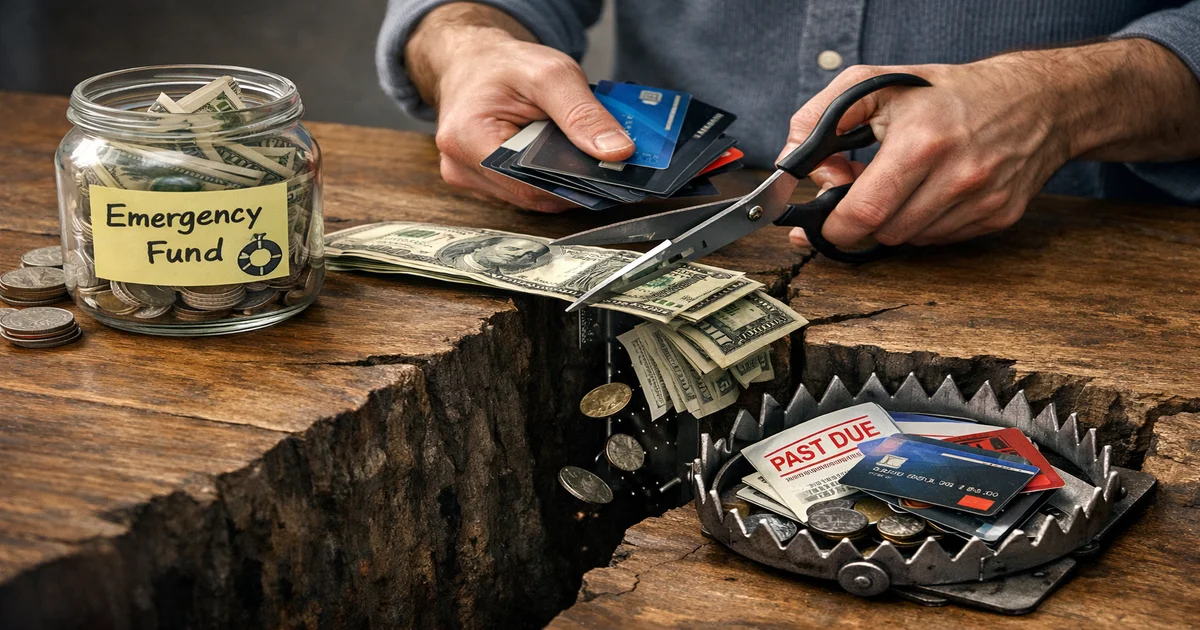
Credit cards aren’t inherently evil, but they’re designed to prioritize spending over saving through sophisticated psychological manipulation. The most successful approach combines both tools strategically: maintain a solid cash emergency fund while using credit cards responsibly for rewards and convenience.
Your emergency fund should be cash you own, not credit you can borrow. Credit cards can complement your emergency strategy, but they should never replace actual savings. The difference between owned money and borrowed money is the difference between financial security and financial vulnerability.
Stop letting credit card psychology sabotage your financial security. Build that emergency fund first, then use credit cards as tools rather than crutches. Your future self will thank you when real emergencies arise and you have actual money to handle them instead of expensive debt that makes everything worse.
Frequently Asked Questions
Should I pay off credit cards or build an emergency fund first?
Build a $1,000-$2,000 starter emergency fund first, then aggressively pay off high-interest credit card debt while maintaining that buffer.Can I count my credit card limit as part of my emergency fund?
No, credit limits are borrowed money with interest costs, not owned money like savings accounts that work for you.How do credit cards psychologically affect spending habits?
Cards reduce spending pain through payment depreciation, making you spend 12-18% more than with cash for identical purchases.What’s the biggest mistake people make with credit cards and emergency funds?
Using credit cards for emergencies while keeping cash savings untouched to “preserve” them, which costs more in interest than savings earn.How much should I save in emergency funds if I have credit cards?
Still aim for 3-6 months of expenses in cash, regardless of available credit limits or rewards programs.
