

How to Stay Safe on Dating Apps: Features That Help
I’ve been on dating apps on and off for years, and I’ll be honest — the safety side of things used to feel like an afterthought. You’d swipe, match, chat, and then just… hope for the best.
The problem is most people never turn them on.
TL;DR
- Match Group partnered with Garbo to pilot background checks on matches, starting on Tinder, with limited availability.
- Noonlight’s panic button (used by Tinder and others) connects you to emergency services with one tap.
- Photo verification confirms the person holds the phone but does not verify name, age, or intentions.
But the industry has changed a lot, and some apps now have safety features that genuinely reduce your risk of harm.
This isn’t a scare piece. Online dating works — millions of real relationships start on apps every year. But knowing which features to use, and which red flags to watch for, is the difference between a great experience and a nightmare one.
What Safety Features Do Dating Apps Actually Offer Now?
The gap between apps is massive. Some have invested seriously in user protection. Others still rely on a basic report button and a prayer.
Here’s what the better apps offer in 2026:
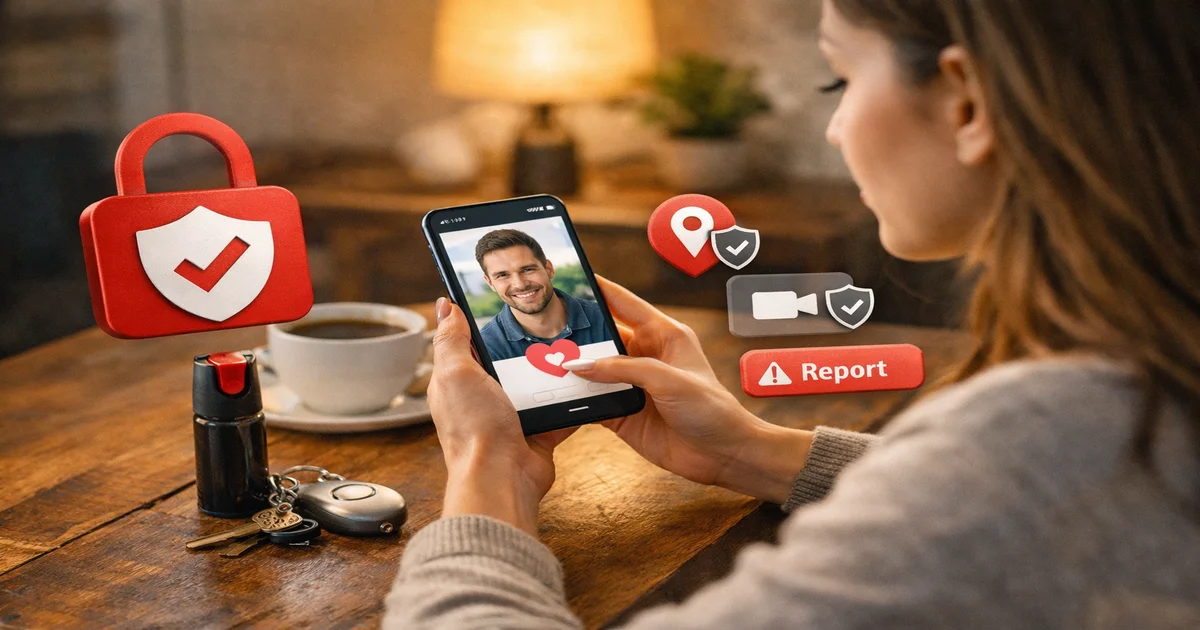
- Photo verification — You take a selfie matching a pose, and the app confirms you’re a real person. Hinge, Bumble, and Tinder all have versions of this.
- Background check integrations — Match Group partnered with Garbo to let some users run background checks on matches, rolled out as a limited pilot starting on Tinder rather than a broadly available free feature across every app.
- Video call features — Built-in video chat (like Bumble’s in-app video) means you can verify someone before meeting without sharing your personal number.
- Location sharing — Some apps let you share your live location with a trusted contact during a date.
- Panic button — Noonlight integration (used by Tinder and others) connects you to emergency services with one tap.
The features exist. The question is whether you’re actually using them.
Is Photo Verification Enough to Confirm Someone Is Real?
Short answer: no, but it helps a lot. Photo verification confirms that the person in the profile photos is the same person holding the phone. It does not confirm their name, age, or intentions.
Catfishing is still possible even with verified photos — someone can verify as themselves but still lie about everything else. What verification does eliminate is the classic stolen-photo scam, where someone uses a model’s photos to build a fake identity.
My honest take: always prioritize matches with a verified badge, but don’t treat it as a green light. It’s one layer of protection, not the whole shield.
Bumble’s verification process is currently one of the more thorough ones — it cross-references your selfie against your profile photos using AI. Hinge added a similar system in late 2024. If an app you’re using doesn’t offer any verification, that’s worth factoring into how cautious you are.
How Do You Spot a Fake Profile Before It’s Too Late?
This is where experience matters more than any app feature. I’ve seen enough fake profiles to recognize the patterns fast.
Red flags that almost always mean fake:
- Profile photos look professionally lit or model-quality with no casual shots
- Bio is vague or weirdly poetic (“I love adventures and deep conversations”)
- They move very fast — love bombing within the first few messages
- They claim to be overseas for work (military, oil rig, doctor with Doctors Without Borders)
- They avoid video calls with excuses every single time
- They ask for money, gift cards, or crypto — ever, for any reason
That last one is the clearest signal. No legitimate romantic interest will ever ask you for financial help within weeks of meeting online. That’s a romance scam, and according to the FTC’s 2025 Consumer Sentinel report, Americans lost over $1.3 billion to romance scams in 2024 alone.
If something feels off, it probably is. Trust that instinct.
Should You Do a Background Check on Your Match?
I think this is underused and underrated. Match Group’s partnership with Garbo piloted a way for some users, starting on Tinder, to run a background check on someone using just their first name and phone number, though availability has been narrow rather than universal across all its apps. It surfaces public records including violent crimes and sex offender registry status.
Is it perfect? No. It only catches people with a documented history. But it’s free, it takes two minutes, and it gives you information you’d otherwise never have.
Here’s my personal rule: for anyone I’m meeting in person for the first time, I run a quick search. Not because I assume the worst, but because it’s the same logic as locking your car door — most of the time nothing happens, but the one time it matters, you’ll be glad you did it.
Other tools worth knowing:
- Google reverse image search — drag their photo into Google Images to see if it appears elsewhere online
- Social media cross-check — a real person usually has a consistent presence across platforms
- LinkedIn check — if they claim a specific job or company, verify it exists
What Should You Do Before Meeting Someone in Person?
This is where most people get careless. The excitement of a good connection can make you rush the in-person meeting before you’ve done basic due diligence.
Here’s what I do before any first date:
- Video call first — at least once, even briefly. It confirms they look like their photos and gives you a gut-check on their vibe.
- Tell someone where you’re going — a friend or family member should know the location, the person’s name, and when to expect you back.
- Meet in public — always. Coffee shops, restaurants, parks. Never a private home for a first meeting.
- Drive yourself or use your own rideshare — don’t accept a ride from someone you’ve never met in person.
- Keep your address private — don’t share your home or work address until you genuinely trust the person.
- Check in with someone mid-date — a quick “all good” text to a friend is a normal thing to do.
None of this is paranoid. It’s just smart. And honestly, anyone worth dating will respect these boundaries without question.
Which Dating Apps Have the Best Safety Features in 2026?
Not all apps are equal here. Based on what’s actually available right now, here’s how the major players stack up:
Bumble — Strong verification, in-app video and voice calls, a Private Detector feature that blurs unsolicited explicit images before you see them. One of the better-designed safety ecosystems.
Tinder — Noonlight panic button integration, photo verification, and the Garbo background check access. Has improved significantly from its early days.
Hinge — Photo verification added in 2024, clear reporting tools, and a focus on verified identity. Owned by Match Group so benefits from their broader safety investments.
OkCupid — Solid reporting features, but lags behind on proactive safety tools like background checks or panic buttons.
Grindr — Has faced criticism for safety issues historically, but added PIN protection, discreet app icons, and improved reporting in recent updates. Still room to grow.
If safety is a top priority for you — and it should be — Bumble and Tinder currently offer the most comprehensive toolkits.
What Are the Biggest Mistakes People Make With Dating App Safety?
Honestly, the biggest mistake is assuming the app will protect you automatically. The features are there, but they’re opt-in. Most people never activate them.
The second biggest mistake: oversharing too early. Your last name, your workplace, your neighborhood, your daily routine — this information builds a profile that someone with bad intentions can exploit. Keep early conversations general until you’ve established real trust.
Third: ignoring gut feelings because the person is attractive or charming. Charm is not a safety signal. Some of the most dangerous people are also the most charismatic. If a conversation makes you uncomfortable, you owe no one an explanation for ending it.
And finally — don’t let embarrassment stop you from reporting. If someone sends you unsolicited explicit content, threatens you, or behaves in a way that feels threatening, report it in the app immediately. These reports actually matter. Apps use them to identify and remove bad actors.
Final Thoughts on Staying Safe While Dating Online
Dating apps are genuinely one of the best ways to meet people in 2026 — but only if you approach them with the same awareness you’d bring to any other part of your life. The safety tools are better than they’ve ever been. Use them.
Turn on photo verification. Do the background check. Video call before you meet. Tell a friend where you’re going. These aren’t dramatic precautions — they’re just the baseline for smart online dating.
The goal isn’t to be fearful. It’s to be informed enough that you can actually relax and enjoy the process. When you know you’ve done your due diligence, you can focus on what actually matters: finding a real connection with a real person.
Frequently Asked Questions
-
Which dating app has the best safety features in 2026?
Bumble and Tinder currently lead with photo verification, background check access, in-app video calls, and emergency contact features built into the platform. -
How can I tell if someone on a dating app is a scammer?
Watch for fast emotional escalation, refusal to video call, claims of being overseas, and any request for money or gift cards — these are the clearest scam signals. -
Is it safe to give someone your phone number on a dating app?
Wait until you’ve video called and feel genuinely comfortable. Use the app’s built-in messaging as long as possible — it keeps your number private and gives you a reporting trail. -
What should I do if I feel unsafe on a first date?
Leave immediately without explanation if needed. Apps like Tinder have a Noonlight panic button you can activate discreetly. Always have your own transportation arranged in advance. -
Do dating app background checks show everything?
No — they only surface public records and registered offenses. Someone with no prior record won’t appear, so background checks are one layer of safety, not a complete guarantee.